
Renting a car in Italy is an experience all its own – with its own rules, quirks, and pitfalls. This guide is based on my personal experience after renting cars more than 50 times across different countries. I’ll cover where to find the best deals, which companies to avoid, how to dodge ZTL fines, and what to check when you pick up the keys.
Car hire in Italy is surprisingly affordable – though prices vary quite a bit depending on the season and how many days you need. In 2026, rates start from as little as €5-15 per day in the low season (November to March), rising to €40-80 or more in summer. Economy cars like the Fiat Panda or Opel Corsa are the most budget-friendly options.

Renting at the airport is still your best bet for value – just make sure you book in advance, not when you land!
In the past I’ve found cars for as little as €2-3 a day, though summer rates are always significantly higher and there’s more to it than the headline price. Don’t worry – I’ll walk you through everything.
Best places to search for car rental in Italy:
Site #1 – the widest selection across Italy, with the best prices. This is the platform I personally use for car hire in Italy, and I recommend it without hesitation.
In Milan alone, they list over 3,900 vehicles from more than 40 rental companies. Somehow their prices are often cheaper than going directly to the rental company.
They also offer their own insurance (full coverage) priced at €7-12 per day in 2026, depending on the car class and rental duration – check the current rate at booking. Either way, that’s 2-3 times cheaper than the full coverage you’d buy directly from a rental company.
To book, you’ll need a Visa, Mastercard, or American Express debit or credit card.
Search example for 8 days in Milan in April 2026:
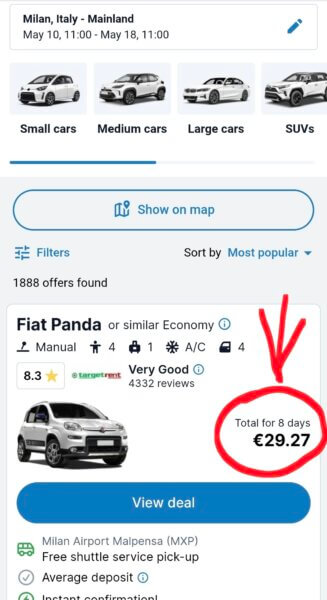
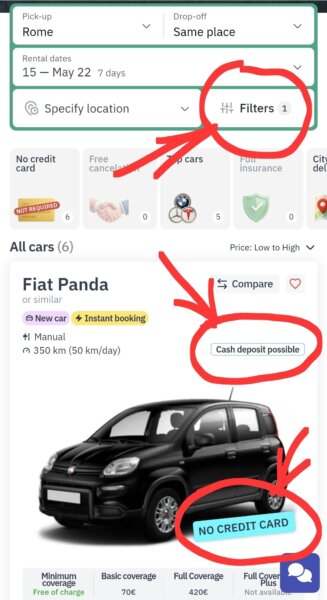
Site #2 – smaller selection, but they’re growing. Payment accepted by any card, including GPay and Apple Pay. You can rent a car in Rome, Milan, Bari, Bergamo, Catania, Naples, Palermo, Pisa, Venice, Florence and other cities.
In this guide I’ll cover where to find the best car rental deals in Italy and which companies to steer clear of. You’ll learn what documents you need, what restrictions apply, and how to rent without a large deposit.
We’ll also look at driving in Italy, the highway toll system, where to park (including a list of convenient car parks I’ve used myself), fuel costs, which navigation app works best, and much more.
I’d strongly recommend reading through this guide before your trip, as Italy has a lot of specific quirks – from finding and booking the right car to navigating accommodation options on the road.
- What You Need to Rent a Car in Italy
- Best Car Rental Companies in Italy – and Which to Avoid
- Car Rental Italy with No Deposit – or a Reduced One
- How to Find a Car with a Low Deposit or No Deposit
- Car Rental Italy Without a Credit Card
- Finding a Car with a Low Excess
- Tips for Choosing and Booking Your Rental Car
- Common Mistakes When Renting a Car in Italy
- My Personal Car Rental Experience in Rome – Is Full Coverage Worth It?
- How to Book on DiscoverCars – Step by Step
- What to Do When You Pick Up the Car
- Car Rental at Rome Airports – Fiumicino and Ciampino
- Rome Airport Car Rental Comparison
- Ciampino Airport (Giovanni Battista Pastine)
- Fiumicino Airport
- ZTL Zones – The Most Important Thing to Know Before Driving in Italy
- ZTL in Rome
- Driving in Italy – What You Need to Know
- Key Traffic Rules in Italy
- What Driving in Italy is Actually Like
- Practical Driving Tips for Italy
- Traffic Fines in Italy
- Parking in Italy
- Important: Consider Parking When Choosing Accommodation
- Motorway Tolls in Italy
- Navigation Apps for Driving in Italy
- Which App to Use
- A Note on ZTL and Navigation Apps
- Should You Rent a GPS from the Rental Company?
- Fuel – Prices, Stations and How to Pay
- Frequently Asked Questions – Car Rental in Italy
- Do I need an International Driving Permit to rent a car in Italy?
- Can I rent a car in Italy with a debit card?
- How much is the security deposit for car hire in Italy?
- Can I drive a rental car to other countries?
- What should I do if I have an accident in a rental car in Italy?
- How much do Italian motorway tolls cost?
- When is the best time to book a rental car in Italy?
- Useful Information for Travelling Around Italy by Car
What You Need to Rent a Car in Italy
- Age: 18-21 minimum, up to 75 maximum – varies by company and car type. The sweet spot is 25+; younger drivers often pay a surcharge of €10-20 per day. Premium cars frequently have a minimum age of 25. Check the specific terms for the company and vehicle class you’re booking.
- At least one year of driving experience.
- A valid passport.
- Your driving licence with your name written in Latin characters. Some companies also require an International Driving Permit (IDP) – a grey booklet issued in multiple languages.
Not every rental company insists on an IDP, but some will refuse to hand over the keys without one. Goldcar is known to be particularly strict about this. Italian police can also ask for an IDP if they stop you, so it’s worth getting one before you travel. - A credit card to cover the security deposit. In most cases the card must be a credit card (not debit), in the driver’s name, with the name embossed on the front.
Goldcar is again the strictest about this. If you only have a debit card, don’t worry – I’ll explain below how to find companies that accept them.
The card currency doesn’t matter – dollars, pounds, euros – conversion happens automatically. - Your booking voucher with all rental details. This is sent to your email when you book online.
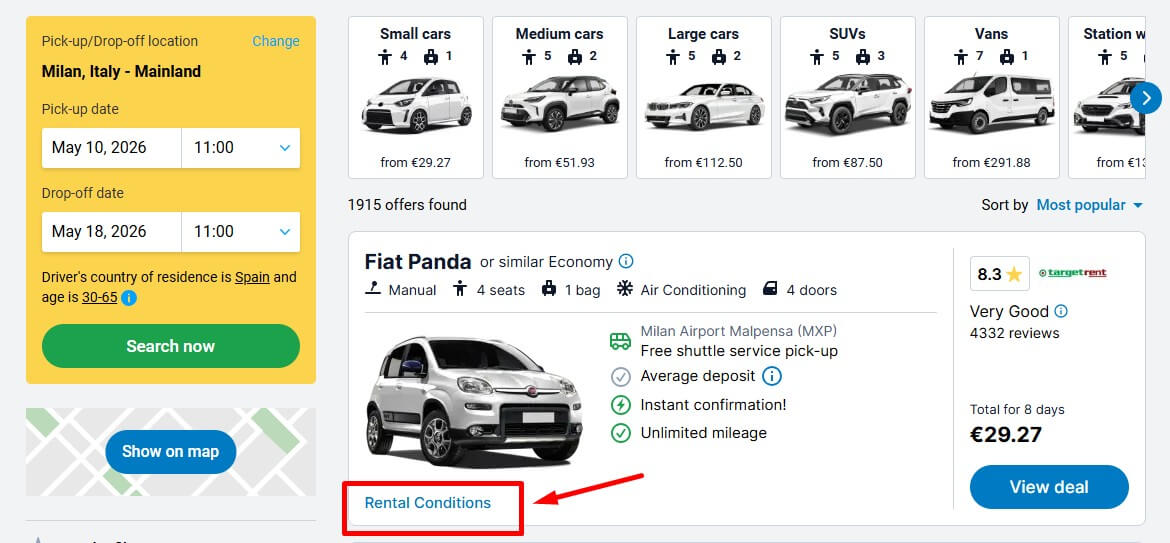
Before you confirm any booking, read the “Rental Terms” carefully – they appear next to each car in the search results. Conditions vary significantly between companies:
Best Car Rental Companies in Italy – and Which to Avoid
I regularly use a couple of trusted platforms with clean interfaces and competitive prices:
Both aggregate offers from local Italian and international rental companies. I’ve written more about them in my general guide to car hire in Europe.
I recommend checking both sites – prices do differ, and the same car might be cheaper on one than the other. There’s no single platform that always wins on price.
It’s important to understand that DiscoverCars and EconomyBookings are not rental companies – they’re booking platforms that search across dozens of suppliers.
Because they work on commission from rental companies and deal in high volume, their prices are often lower than booking directly with the supplier.
They also show prices with all mandatory insurance already included – unlike some suppliers who advertise a low base rate and add compulsory insurance at the counter.
I’ve been using these platforms for years and consistently find them cheaper and more convenient than going direct.
The best strategy is to pick up your car as soon as you land and drop it off just before your return flight. Italian airports have strong competition between suppliers, which keeps prices down.
Avoid the very cheapest offers (€3-10/day) from questionable companies. Some lure customers in with rock-bottom prices and then charge heavily for alleged damage or hidden extras.
Goldcar (also operating as Rhodium) has a very low rating and a long trail of complaints across Europe – not just Italy.
There are entire communities of unhappy customers online. Their strategy seems to be: attract clients with unbeatable low prices, then make money through charges and penalties.
I rented from them in Malta and was charged €1,065 for four alleged damages – some of which existed when I picked up the car (visible on video), and some the staff couldn’t even point out when I returned the vehicle.
Their rental agreements are written very carefully in their favour. Complaining gets you nowhere.
In all my years of renting cars around the world, they are the only company I’ve had a genuinely bad experience with. They give you a blank inspection sheet and expect you to mark every scratch yourself – often at night, in poor lighting.
My verdict: avoid them entirely. If you absolutely must use them, take the most comprehensive insurance available – but at that point, the price advantage disappears anyway.
Centauro Rent a Car – I rented from them in Portugal and the experience wasn’t great. Rude staff, a hidden surcharge for late airport pick-up, and a car that was a class below what I’d booked.
That said, reviews of Centauro in Italy are generally more positive – in Rome, for example, they have decent ratings at both airports.
For a hassle-free experience, stick to well-established international companies: Sixt, Europcar, Alamo, Enterprise, Thrifty, Hertz. I’ve used all of these multiple times without issues. Book early, especially in peak season – demand for car hire in Italy is high.
Car Rental Italy with No Deposit – or a Reduced One
When you collect your car, the rental company blocks a security deposit on your card to cover potential damage, a missing fuel top-up, or any fines. This is standard practice everywhere. The amount varies from around €250 to €1,500 or more, depending on the company and vehicle.
To rent a car in Italy without a large deposit, book through DiscoverCars or EconomyBookings with the standard included insurance, then at the counter add full coverage with zero excess. The excess is the maximum amount you’d be liable for in the event of damage.
With zero-excess coverage, your liability for damage is effectively €0 – but with some exceptions.
Most full coverage policies don’t include windscreens, headlights, the underside of the car, or the interior. Many companies offer an additional “super cover” that includes these. Even then, no policy covers drunk driving or deliberate damage.
Taking full coverage doesn’t always eliminate the deposit entirely. Sometimes the blocked amount is simply reduced – for example, from €1,500 down to €300. This gives the company a buffer for any outstanding fines or fuel shortfall.
Keep in mind that full coverage can significantly increase the total rental cost – sometimes doubling or tripling it.
For example: if your base rental is €150, full coverage might add another €150-200, bringing the total to €300-350.
Also note: excess insurance purchased through DiscoverCars or EconomyBookings (labelled “full protection” or “full coverage”) does not reduce the deposit amount.
If damage occurs, you pay the rental company first, get documentation, and then claim the reimbursement from DiscoverCars or EconomyBookings.
How to Find a Car with a Low Deposit or No Deposit
If you’d rather not take full coverage but still want a smaller deposit, use the search filters. Tick “Deposit under €500” or “No deposit” or “No credit card required”. At Rome Fiumicino airport, for example, Hertz, Avis/Budget and Firefly currently offer lower deposits (around €250).
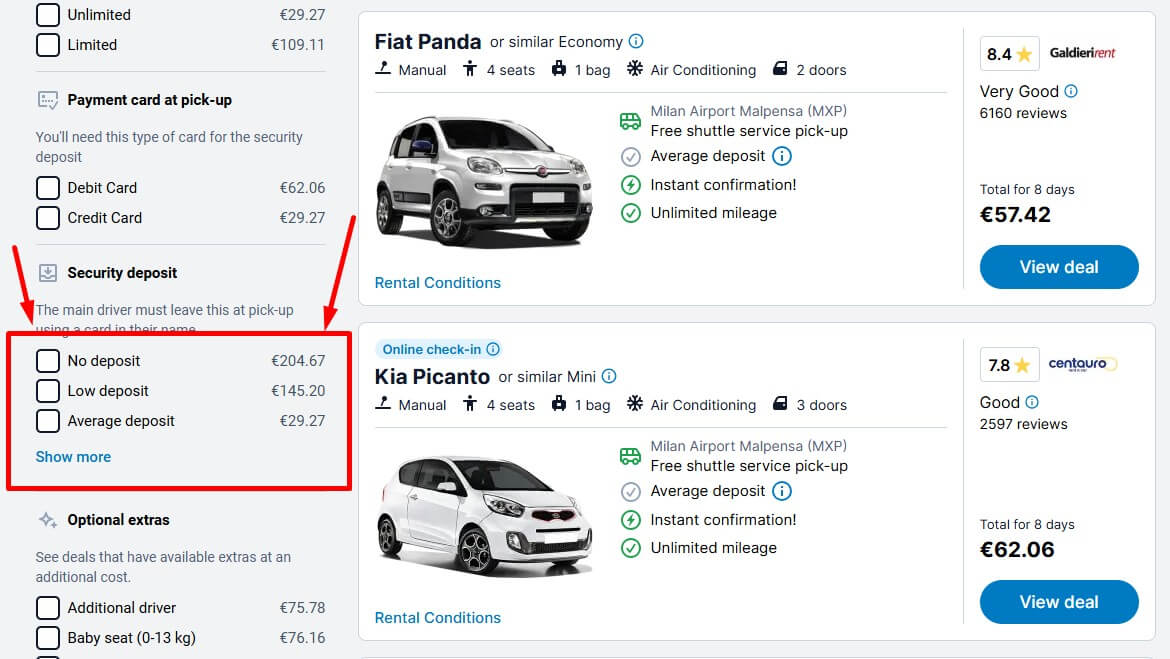
In Milan, you can also find options with no deposit and no card required.
Car Rental Italy Without a Credit Card
To find cars that accept a debit card, use the search filters in the same way:
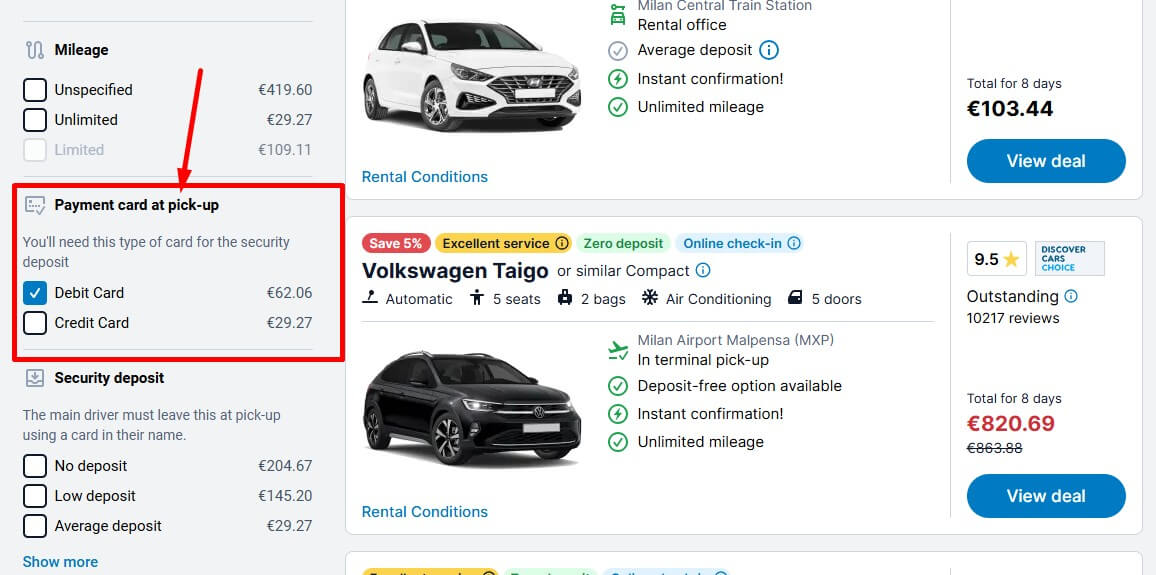
At Rome Fiumicino, companies currently accepting debit cards include: Autovia, Hertz/Thrifty, Avis, Firefly, Europcar/Keddy, Locauto/Enterprise.
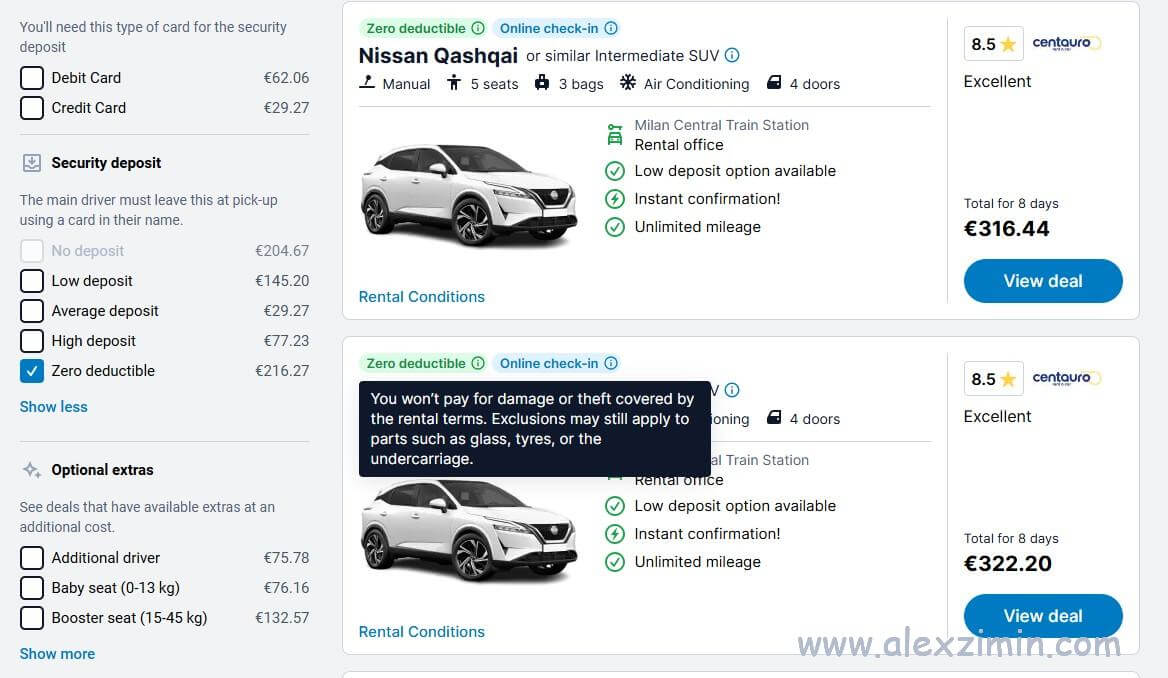
Finding a Car with a Low Excess
Use the filters just as described above:
Tips for Choosing and Booking Your Rental Car
- Use DiscoverCars and EconomyBookings to search and book.
- Avoid Goldcar/Rhodium. Stick to reputable brands that value their reputation: Sixt, Hertz (and its sub-brands Thrifty and Dollar), Europcar, Alamo, Enterprise, National Car Rental.
- The longer the rental period, the lower the daily rate.
- On DiscoverCars and EconomyBookings, all prices include mandatory insurance – liability cover, theft with excess, and collision damage with excess. Some other platforms show prices without this, then charge you at the counter.
- Experienced drivers are usually fine with standard included insurance. If you’re less confident, go for zero-excess cover – you’ll pay more, but your risk is minimal. Just note that even “full” coverage often excludes windows, tyres, the undercarriage and interior.
- On mountain roads or with a full car of passengers and luggage, avoid underpowered engines. Aim for at least 1.4-1.8 litres.
- For fans of Italian cars, there’s a great opportunity to drive a classic Fiat 500, Fiat 500x, Alfa Romeo Giulietta – or even a Maserati or Ferrari. Fiats and Alfa Romeos are widely available; luxury Italian cars can be found on EconomyBookings.
- Italian city centres have very narrow streets. Large cars are uncomfortable and a scratch risk. Go compact – Fiat Panda, Opel Corsa, VW Polo.

Common Mistakes When Renting a Car in Italy
- Booking without checking the deposit amount. It can be €1,500-2,000 – make sure your card has sufficient available credit.
- Forgetting about ZTL zones. Google Maps sometimes routes you through restricted areas. Use Waze or a TomTom with up-to-date ZTL data.
- Choosing the cheapest car from Goldcar or similar. The “saving” often turns into a loss when you return the vehicle.
- Not filming the car at pick-up. Even with full coverage, a video walkthrough protects you against dubious claims.
- Filling up on the motorway. Fuel there is 15-20% more expensive than at a regular town petrol station.
- Parking in a blue zone without paying. Fines range from €40-80; towing starts at €200.
My Personal Car Rental Experience in Rome – Is Full Coverage Worth It?
This was my 30th car hire experience across various countries. As always, I searched on DiscoverCars and EconomyBookings – 11 days in May. I skip the cheapest options and go for a mid-range car from a reliable company. A slightly higher daily rate is worth it for a newer vehicle and peace of mind.
My pick was Sixt at Fiumicino – a company I’d used before in Greece and Switzerland with great results. I chose a BMW 1 Series.
Sixt’s own website quoted €291.19 for 11 days with standard insurance (€26.47/day). EconomyBookings showed €288.73 (€26.25/day) and DiscoverCars came in at €287.48 (€26.13/day).


Here’s the key difference: On DiscoverCars and EconomyBookings, I could add full coverage including glass, mirrors and tyres for just €7.45/day. At Sixt directly, the same full cover would have cost €26/day + €4.75 for glass/mirrors/tyres.
Total with full coverage directly through Sixt: €627.17. Total through DiscoverCars with full protection: €374.93. The difference is enormous.
Naturally, I went with DiscoverCars and full protection at €7.95/day.
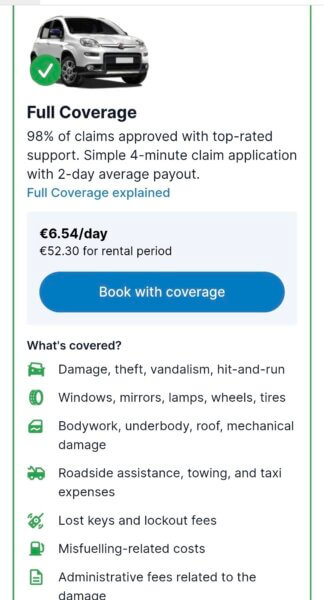
That full protection for €7.95/day covered all damage including glass, mirrors and wheels, theft, and admin fees – everything you’d actually need:
I have a lot of rental experience and don’t usually take full cover. But in this case the excess was €1,500 for damage and €2,200 for theft – significant sums, especially after reading about chaotic traffic in Naples and a rise in car theft in central and southern Italy. Paying €7.95 x 11 = €87 for peace of mind made complete sense.
How to Book on DiscoverCars – Step by Step
I’ll walk through the booking process on DiscoverCars – the process is similar on other platforms.
Start by entering the pick-up city, location, dates, times, and driver age, then hit Search:
The results can be filtered by car type, supplier, specs, or deposit size. On desktop, car type filters appear at the top, with all other filters on the left:
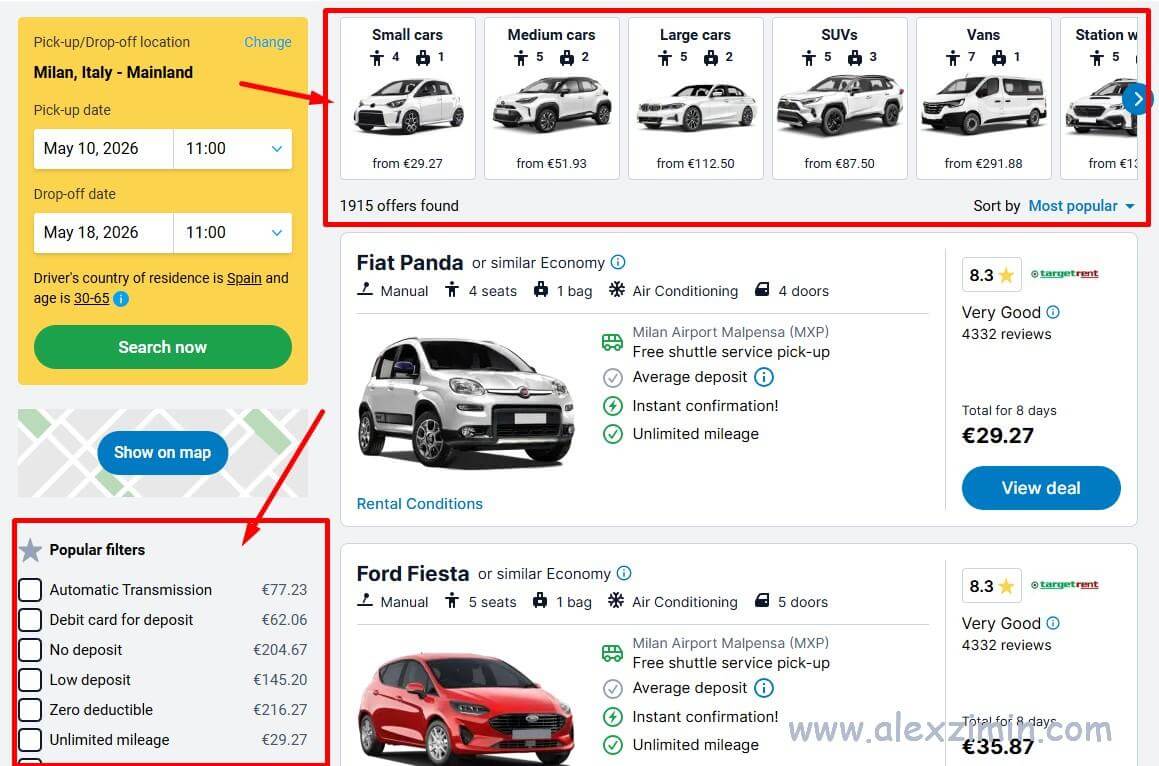
When selecting a car, click “Rental Terms” to see all deposit and excess details.
Pay attention to whether the car offers instant confirmation (secured immediately) or requires the supplier to confirm – always prefer instant confirmation.

Once you’ve chosen your car and reviewed the terms, click BOOK.
Next, choose “Full Coverage” (recommended for Italy, especially the centre and south) or proceed with the standard included insurance if you’re comfortable with the excess. Then add any extras you need – a child seat, booster, or additional driver:
Enter your details – double-check your email address, as your voucher will be sent there. If you’re picking up at an airport, add your flight number. Then click Book again.
Payment can be made by Visa, Mastercard, or PayPal. Any currency works – conversion is automatic, though paying in euros avoids any conversion fees:

Enter your card details and confirm. You’ll receive a booking confirmation and full voucher by email. Print or save it, and you’re ready to go.
Always bring your passport, driving licence, and credit card.
What to Do When You Pick Up the Car
Practical tip: when collecting the car at night or in poor lighting, film a full video walkthrough using your phone’s torch. Scratches and chips show up much more clearly on video than in photos.
- If your flight is delayed significantly, call the rental office – the number is in your voucher. Long delays can give them the right to cancel your booking.
- Even with full coverage, inspect the car carefully for existing damage, photograph everything, and film all four sides including the roof. Check windows, mirrors, wheels, and the interior. Report any damage to staff so it’s noted in the inspection form.
- If the car has remote locking, also test the key in the door lock. In Italy there have been cases where undiscovered door lock faults were charged to the renter on return.
- Check the fuel level against the amount stated in your contract. You’ll normally need to return the car with the same level.
- Confirm the fuel type – petrol or diesel – and how to open the fuel cap.
- Ask whether you return the car to the same spot, or a different one. Save the location in your navigation app – large airports like Fiumicino are easy to get turned around in.
- Ask whether you need an exit ticket to leave the car park – most airport car parks require one to open the barrier.
- Always take your copy of the rental agreement.
- Before driving off: adjust the seat, set up the mirrors, and familiarise yourself with the indicators and hazard lights.
- In Italy, headlights must be on outside built-up areas during the day (unless the car has daytime running lights). Fog lights are only permitted in actual fog, heavy rain, or snow.

Car Rental at Rome Airports – Fiumicino and Ciampino
Rome has two airports. The main one – Fiumicino (FCO), officially Leonardo da Vinci International Airport – handles most international flights. The second, Ciampino (CIA), is used mainly by budget carriers: EasyJet, Wizz Air, and Ryanair.
Rome Airport Car Rental Comparison
| Detail | Fiumicino (FCO) | Ciampino (CIA) |
|---|---|---|
| Airlines | Most international carriers | Ryanair, Wizz Air, EasyJet |
| Number of suppliers | Around 20 | Around 10 |
| Desk opening hours | 07:00-24:00 | Varies by supplier |
| Recommended companies | Sixt, Locauto, Win Rent, Firefly | Sixt, Europcar, Hertz |
| Avoid | Goldcar/Rhodium, Budget/Avis | Goldcar/Rhodium, Budget |
| Desk location | Separate building, walkway from T3 | Via Mario Mameli, car parks P6-P8 |
Ciampino Airport (Giovanni Battista Pastine)
A smaller airport with around ten rental companies. Good ratings at Sixt, Centauro Rent a Car, Sicily by Car, Win Rent, Europcar and Hertz.
Goldcar/Rhodium and Budget have poor reviews here – avoid both.
The rental car parks at Ciampino are along Via Mario Mameli, car parks P6-P8, coordinates (41.796560, 12.589387):
Fiumicino Airport
Italy’s busiest airport, served by around 20 rental companies – more than I’ve seen at any other airport.
Best-rated companies: Sixt, Centauro Rent a Car (off-site with shuttle), Win Rent, Firefly, Sicily by Car, Locauto (also operating as Alamo, Enterprise and National), Thrifty and Hertz.
Poorest reviews: Goldcar/Rhodium, Budget/AVIS, Autonoleggio, Maggiore Aeroporto Roma.
Desks operate 07:00-24:00 (some, like Centauro, close at 23:00).
This video shows the car rental process at Fiumicino airport:
All rental companies are located in a separate building. After passport control and baggage claim, exit to the arrivals area. Take the lift on the left up to the second floor and follow the Car Rental signs:

All buildings are connected by covered walkways with moving walkways – no need to go outside. It’s about a 5-7 minute walk.

Once you’ve completed the paperwork, staff will direct you to the rental car park – also connected by covered walkway.
Car parks at Fiumicino:
– Hertz, Firefly, Thrifty, Dollar, Budget/AVIS, Maggiore – Car Park A
– Sixt, Europcar, Goldcar/Rhodium, Autovia, Winrent – Car Park B (pB)
– Locauto (with Alamo, Enterprise and National), Sicily by Car, Rent4U, KarymRent – Car Park C


Inspect the car thoroughly before driving off and save the car park location in your navigation app – you’ll need to find it again at drop-off.
To exit the car park, take an exit ticket at the barrier. You’ll need this ticket again at the airport perimeter barrier to get out.
ZTL Zones – The Most Important Thing to Know Before Driving in Italy
ZTL stands for Zona a Traffico Limitato – restricted traffic zones found in Italian cities. They’re marked by specific signs and usually cover the historic centre, where parking is severely limited. Entry is permitted only for residents and service vehicles.
The fine for entering a ZTL zone in Italy is €80-150 for a first offence. If you pass multiple cameras, fines are issued separately for each. The catch: fines don’t arrive immediately – they land with the rental company 3-6 months later, who then charges your card plus an admin fee of €15-30 on top.
ZTL in Rome
Rome has both daytime and night-time ZTL zones. Watch this video for a detailed explanation (from 34 minutes 04 seconds):
Driving in Italy – What You Need to Know
Italian roads are generally excellent, signage is clear, and navigation is straightforward. But there are a few things worth knowing before you set off – especially if it’s your first time.
Key Traffic Rules in Italy
- Speed limits: 50 km/h in towns, 90 km/h on rural roads, 110 km/h on main roads, 130 km/h on motorways (110 km/h in rain). Drivers with less than 3 years’ experience are limited to 100 km/h on motorways.
- Headlights: required outside built-up areas and in tunnels – dipped headlights or daytime running lights. Fog lights only in actual fog or heavy rain. Fine for non-compliance: €42.
- Alcohol limit: 0.5 per mille for most drivers; 0.0 for those with less than 3 years’ experience. Fines start at €532; higher readings can result in criminal charges.
- Mobile phones: hands-free only. Fine: from €165 plus up to 3 months’ licence suspension.
- Seatbelts: compulsory for all passengers on all seats.
- Roundabouts: traffic already on the roundabout has priority. Roundabouts are extremely common in Italy.
- Pedestrians: you must give way before they step onto a zebra crossing, not after. Fine: from €167.
- Reflective vest: must be kept in the passenger compartment (not the boot). Put it on before getting out of the car on a motorway. Fine for not having one: €41-169.
What Driving in Italy is Actually Like
Italians drive fast and confidently – particularly in cities. Don’t hesitate in heavy traffic; the flow won’t wait for you.
On motorways, move back to the right lane immediately after overtaking – this is taken seriously, and anyone behind you will make their feelings known quickly.
The biggest surprise for most visitors: scooters and motorbikes. There are huge numbers of them, they appear from everywhere, and their behaviour isn’t always predictable – filtering between lanes, overtaking on the right, appearing from behind parked cars. Check your mirrors frequently, especially before turning or changing lane.
Naples is a special case. Traffic lights there are widely treated as suggestions rather than rules – that’s not an exaggeration. If you’re driving in Naples for the first time, expect chaos and proceed with real caution. I recommend parking on the outskirts and exploring the centre on foot.
Practical Driving Tips for Italy
- Historic city centres have extremely narrow streets. A large car will be uncomfortable and expensive in terms of scrape risk. Go compact.
- Sunday is a good day for long motorway drives – lorries are banned. But coastal roads on summer weekends can be heavily congested.
- Never leave valuables visible in the car. Theft from parked vehicles is a real issue in cities, especially Rome, Naples and the south. Even a bag on the back seat is worth moving to the boot.
- Avoid filling up on the motorway unless necessary – it’s 15-20% more expensive than town stations. On weekends, many small-town stations are unstaffed and operate via machine only, so don’t let the tank drop below a quarter.
- When approaching a motorway queue, Italians switch on their hazard lights – it’s an unwritten rule that’s strictly observed. If you see hazards ahead, brake immediately and put yours on too.
- Most paid street parking is free between 20:00 and 08:00. Factor this into your city arrival time.

Traffic Fines in Italy
Current for 2026. Amounts shown are for a first offence.
| Offence | Fine |
|---|---|
| Entering a ZTL zone | €80-150 |
| Parking in a blue zone without paying | €40-80 |
| Using a mobile phone while driving | from €165 |
| Speeding up to 10 km/h over | €42-173 |
| Speeding 10-40 km/h over | €173-694 |
| Speeding more than 40 km/h over | from €829 + licence suspension |
| Drink driving 0.5-0.8 per mille | from €532 |
| No reflective vest in the car | €41-169 |
Parking in Italy
Street parking follows a colour-coded system familiar from many countries:
- Blue markings – paid parking; find the pay machine nearby
- White markings – free parking
- Yellow markings – no parking; reserved for service and emergency vehicles

Finding street parking in city centres is difficult. I always look for large underground car parks with barrier entry.
Video guide to paying for parking in Italy (from 15 minutes 14 seconds):
15:14 – Paying at a machine in Rimini. Parking coordinates (Parcheggio Tiberio): 44.064187, 12.562334
18:18 – Underground car park in central Rome – Parking Piazza Cavour. Coordinates: 41.905874, 12.470554
19:55 – Underground car park near the Vatican Museums – Parking Trionfale. Coordinates: 41.908598, 12.452624
24:32 – Underground car park in central Turin – GTT Parking Valdo Fusi. Coordinates: 45.064515, 7.687122
27:03 – San Gimignano car park P2. Coordinates: 43.464612, 11.041523
28:24 – Siena city centre parking. Coordinates: 43.317777, 11.324958. Free escalators lead to the centre.
30:23 – San Marino parking. Coordinates: 43.928906, 12.451648
31:14 – Central Naples – Vesuvio Parking Srl, €3/hour. Coordinates: 40.857436, 14.252992
The process is simple: take a ticket at the barrier on entry, park, explore, then pay at the machine by card or cash on your return.


Important: Consider Parking When Choosing Accommodation
When planning your route and booking accommodation, always check parking availability. This is especially important in city centres – Rome, Milan, Naples, Florence. Sorting this out in advance avoids real headaches.
We usually stay in apartments with a kitchen – the best options are on Airbnb and Booking.com.
On Airbnb, use the “Free parking” filter – it won’t show many central properties, but for a road trip it’s worth prioritising.
On Booking.com, use the “Parking” filter – note it covers both paid and free options. Check the details for each property, as on-site parking can cost €20-30 per night.
I always filter by review score 8+ and parking availability.Once you’ve chosen a property, the Facilities section will give full details on the car park – including whether it’s free or paid:
Interactive map of Florence car parks with prices
Motorway Tolls in Italy
Full guide to paying Italian motorway tolls:
Detailed video guide from 2 minutes 33 seconds:
Navigation Apps for Driving in Italy
GPS works without a SIM card – satellite signals don’t need mobile data. But live traffic, real-time updates, and ZTL data all require an internet connection. Either get a local SIM or eSIM before you travel, or download offline maps at home.
Which App to Use
Google Maps – the best all-round option. Knows Italian roads well, shows live traffic, warns about toll roads, and lets you download offline maps.
Downside: ZTL zones aren’t always accurately marked, and it occasionally routes through restricted areas.
Waze – the best choice when you have mobile data. Uses real-time community input: alerts for speed cameras, accidents, police, and roadworks. Better at avoiding jams than Google Maps in city traffic. Doesn’t work offline.
Maps.me (or Organic Maps) – free offline navigation. Download Italy’s maps at home over Wi-Fi; they work without any data connection. Good for routing and points of interest, but no live traffic. Ideal as a backup – or as your main app if you don’t want a local SIM.
What I use: Google Maps + Waze as my main apps, Organic Maps as backup with Italy downloaded in advance. Before leaving the airport I download the regions I need over the airport Wi-Fi – takes 3-5 minutes. I also pre-download Google Maps offline regions at home before the trip.
A Note on ZTL and Navigation Apps
No app guarantees 100% protection from ZTL zones. Google Maps in particular sometimes routes through restricted areas, especially in smaller towns. Before entering any Italian city centre, check the ZTL boundaries in advance by searching “[city name] ZTL map”.
Should You Rent a GPS from the Rental Company?
Rental companies offer GPS units for €8-15/day. Skip it – it’s a waste of money. A smartphone with Google Maps or Waze works better, updates automatically, and costs nothing extra. The only thing worth bringing is a car phone mount – buy one before you travel.
Fuel – Prices, Stations and How to Pay
Motorway service stations are always more expensive. Pull off at the next town instead. On weekends, many stations run unattended – you’ll need to use the self-service machines.
How to pay for fuel at a self-service machine in Italy:
Also covered in this video from 38 minutes 37 seconds:
Frequently Asked Questions – Car Rental in Italy
Do I need an International Driving Permit to rent a car in Italy?
Technically no – for most rental companies, a driving licence with your name in Latin characters is sufficient. But an IDP is worth having for police checks. Goldcar requires one without exception.
Can I rent a car in Italy with a debit card?
Yes, but not with every company. Filter by “Debit card accepted” on DiscoverCars or EconomyBookings. At Fiumicino, Hertz, Avis, Europcar, Firefly and others accept debit cards.
How much is the security deposit for car hire in Italy?
Typically €250-2,000 depending on the company and car class. To reduce it, filter for “Deposit under €300” or take full coverage insurance.
Can I drive a rental car to other countries?
It depends on the rental agreement. Most companies allow travel within the EU but require advance notice and may charge extra. Driving into non-EU countries like Montenegro or Bosnia is often prohibited or requires a separate permit.
What should I do if I have an accident in a rental car in Italy?
Call the police (112), even for minor incidents – without a police report, your insurance may not pay out. Photograph the scene, any damage, and the other driver’s documents. Then call your rental company using the number in your contract.
How much do Italian motorway tolls cost?
Around €9-10 per 100 km for a standard car. Typical 2026 costs on popular routes: Rome – Naples (225 km): €18-22; Milan – Venice (280 km): €15-19; Milan – Rome (573 km): around €40-45; Venice – Florence: €15-20. Payment by cash or card. Telepass is not usually available on rental cars. Calculate your exact route in advance at autostrade.it.
When is the best time to book a rental car in Italy?
The earlier the better. In summer (June-August), cars sell out 2-3 months ahead, and prices can be 2-3 times higher than in winter. Book 1-2 months out for the best combination of availability and price. Most platforms allow free cancellation up to 48-72 hours before pick-up.
Useful Information for Travelling Around Italy by Car
- Country code: +39. Rome city code: 06. To call Rome: +3906…
- Emergency number: 112. Police: 113. Ambulance: 118. Fire: 115.
- Interactive map of Italian toll roads with live traffic
- Live fuel price map across Italy
- Rome and Milan travel guides
- Mobile data in Italy: excellent value with eSIM from AIRALO. Six packages available for Italy, from 1GB for €4 to 20GB for €24.50. You can activate everything online before you leave home. Check whether your phone supports eSIM here.
Share your own tips or experiences in the comments below.
Alex Zimin


Hi Alex,
Thanks for all the recommendations.
I´m travelling to Italy next month. I was wondering if it is necessary to show the International Driving Permint to rent a car.
Thanks